Every KCML data type — write in KCML, read in Python (worked example)
This example builds on the KISAM create/write/read page. It writes a
single KISAM record carrying one field of every writable KCML data type, then
reads the raw file back in Python with struct — decoding each field from its
on-disk bytes and checking the result against a ground-truth file the KCML program
writes alongside it. It's a guided tour of how KCML actually stores each type.
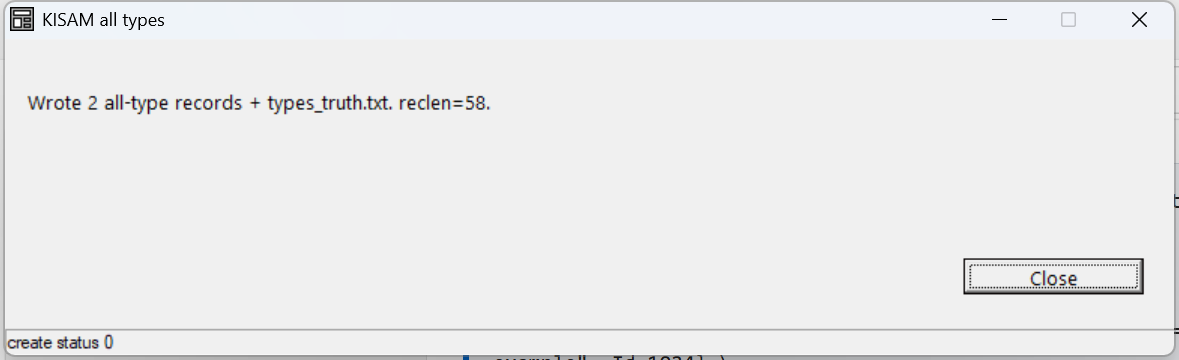
Verified by execution on KCML 06.00.88 (KClient direct mode); Python 3.12.
What it demonstrates
- Encoding one field of every writable KCML type into a fixed-length KISAM record.
- The exact on-disk byte format of each type — big-endian binary integers, packed BCD numbers, Julian and BCD dates, times, flags and raw bytes.
- Building packed values in KCML with
BIN,HEXPACKandCONVERT DATE(because thePACKstatement is broken in 06.00.88). - Reading the file in Python with
structand verifying every field matches what KCML wrote.
The record layout
A fixed 58-byte record. Byte 1 is the KISAM status byte; the typed columns follow. The "dict" column is the KDB data-dictionary type code (see KDB data types).
| Bytes | Dict | Type | Field | On-disk encoding |
|---|---|---|---|---|
| 1 | — | (status) | — | HEX(00) = live record |
| 2–7 | C | VARCHAR | code (key) | ASCII, space-padded |
| 8–27 | C | VARCHAR | name | ASCII, space-padded |
| 28 | B | INTEGER(1) | b1 | 1-byte big-endian unsigned |
| 29–30 | B | INTEGER(2) | b2 | 2-byte big-endian unsigned |
| 31–34 | B | INTEGER(4) | b4 | 4-byte big-endian unsigned |
| 35–37 | J | DATE | jdate | 3-byte big-endian Julian day number |
| 38–41 | L | BCDDATE | bcddate | 4-byte packed BCD CCYYMMDD |
| 42–49 | K | DECIMAL(15,2) | amount | 8-byte IBM packed BCD, sign nibble last |
| 50–52 | T | TIME | time | 3-byte big-endian seconds since midnight |
| 53 | G | BOOL | active | Y/N byte |
| 54 | F | BIT | flag | Y/N/space byte |
| 55–58 | H | HEX(4) | rawhex | 4 raw bytes |
One record, byte by byte
The first record (code = "P00001") on disk, with each slice labelled:
00                       byte 1     status   live record
50 30 30 30 30 31        2-7    C   code     "P00001"
41 6c 69 63 65 ...       8-27   C   name     "Alice Walker" (space padded)
2a                       28     B   b1       0x2a            = 42
03 e8                    29-30  B   b2       0x03e8          = 1000
00 0f 42 40              31-34  B   b4       0x000f4240      = 1000000
25 8d cf                 35-37  J   jdate    0x258dcf=2461135 -> 2026-04-04
20 26 04 18              38-41  L   bcddate  BCD             -> 2026-04-18
00 00 00 00 12 34 56 7c  42-49  K   amount   BCD 000000001234567 + sign C -> 12345.67
00 cb f7                 50-52  T   time     0x00cbf7=52215  -> 14:30:15
59                       53     G   active   'Y'
4e                       54     F   flag     'N'
de ad be ef              55-58  H   rawhex   DEADBEEF
Two things to notice: every multi-byte number is big-endian (most significant
byte first), and the packed-decimal amount keeps its sign in the last nibble
(c = positive, d = negative).
Writing it in KCML
The program creates the file (see the KISAM page for KI_CREATE
details), then for each record fills every field with the right encoding and calls
KI_WRITE. It also writes a pipe-delimited types_truth.txt so the Python reader
has something to check itself against.
01000 REM demo_kisam_types - KISAM record with one field of every writable KCML type
    : REM Layout reclen 58 - byte 1 status, 2-7 code C, 8-27 name C, 28 b1 B1
    : REM 29-30 b2 B2, 31-34 b4 B4, 35-37 jdate J, 38-41 bcddate L, 42-49 amount K
    : REM 50-52 time T, 53 active G, 54 flag F, 55-58 rawhex H
    : DIM result, ki_status, handle, ki_sym, ki_dataptr$6, ki_key$64
    : DIM keyspec$(1)33, nrows, reclen, ftype, dictfile$2, file$120, rec$58
    : DIM sv_i, jval, secs, bcd_val, hh, mm, ss
    : DIM n_s$20, pad_s$40, sign$1, hex_s$20, kpacked$8, bcdp$4, rawp$4, gt$200
    : DIM t_code$(2)6, t_name$(2)20, t_b1(2), t_b2(2), t_b4(2)
    : DIM t_jd$(2)10, t_bcd$(2)8, t_amt(2), t_time(2), t_act$(2)1, t_flg$(2)1, t_raw$(2)8
    : file$ = "C:/kisam_data/PEOPLE_TYPES"
    : DIM gtfile$120
    : gtfile$ = "C:/kisam_data/types_truth.txt"
    : nrows = 100 : reclen = 58 : ftype = 6 : dictfile$ = " "
    : t_code$(1) = "P00001" : t_name$(1) = "Alice Walker"
    : t_b1(1) = 42 : t_b2(1) = 1000 : t_b4(1) = 1000000
    : t_jd$(1) = "2026-04-04" : t_bcd$(1) = "20260418" : t_amt(1) = 12345.67
    : t_time(1) = 52215 : t_act$(1) = "Y" : t_flg$(1) = "N" : t_raw$(1) = "DEADBEEF"
    : t_code$(2) = "P00002" : t_name$(2) = "Bob Stone"
    : t_b1(2) = 7 : t_b2(2) = 255 : t_b4(2) = 70000
    : t_jd$(2) = "2025-12-25" : t_bcd$(2) = "20251225" : t_amt(2) = -89.50
    : t_time(2) = 32700 : t_act$(2) = "N" : t_flg$(2) = "Y" : t_raw$(2) = "0BADF00D"
01010 - DEFFORM TypesDemo()=\
       {.form,.form$,.Style=0x50c000c4,.Width=520,.Height=130,.Text$="KISAM all types",.Id=1024},\
       {.lblOut,.static$,.Style=0x50000000,.Left=10,.Top=20,.Width=500,.Height=50,.Text$="(running)",.Id=2001,.Font=.UI},\
       {.btnClose,.button$,.Style=0x50010001,.Left=425,.Top=90,.Width=80,.Height=15,.Text$="Close",.Id=1,.Font=.UI},\
       {.paneStatus,.status$,.Width=520,.Style=0x50000000,.Text$="Ready"},\
       {.UI,.dlgfont$,.Name$="Segoe UI",.Size=10}
    :     + DEFEVENT TypesDemo.Enter()
    :         keyspec$(1) = ALL(HEX(00))
    :         STR(keyspec$(1), 1, 1) = "N"
    :         STR(keyspec$(1), 2, 2) = BIN(2, 2)
    :         STR(keyspec$(1), 4, 1) = BIN(6)
    :         CALL KI_ALLOC_HANDLE 0, 1 TO handle, ki_status
    :         CALL KI_CREATE handle, file$, dictfile$, nrows, reclen, SYM(keyspec$()), 4, 50, ftype TO ki_status
    :         OPEN #1, gtfile$, "w"
    :         FOR sv_i = 1 TO 2
    :             rec$ = ALL(HEX(20))
    :             STR(rec$, 1, 1) = HEX(00)
    :             STR(rec$, 2, 6) = t_code$(sv_i)
    :             STR(rec$, 8, 20) = t_name$(sv_i)
    :             STR(rec$, 28, 1) = BIN(t_b1(sv_i), 1)
    :             STR(rec$, 29, 2) = BIN(t_b2(sv_i), 2)
    :             STR(rec$, 31, 4) = BIN(t_b4(sv_i), 4)
    :             CONVERT DATE t_jd$(sv_i) TO jval
    :             STR(rec$, 35, 3) = BIN(jval, 3)
    :             HEXPACK bcdp$ FROM t_bcd$(sv_i)
    :             STR(rec$, 38, 4) = bcdp$
    :             bcd_val = ROUND(ABS(t_amt(sv_i)) * 100, 0)
    :             n_s$ = $PRINTF("%d", bcd_val)
    :             pad_s$ = "000000000000000" & RTRIM(n_s$)
    :             sign$ = "C"
    :             IF t_amt(sv_i) < 0 THEN sign$ = "D"
    :             hex_s$ = STR(RTRIM(pad_s$), LEN(RTRIM(pad_s$)) - 14, 15) & sign$
    :             HEXPACK kpacked$ FROM hex_s$
    :             STR(rec$, 42, 8) = kpacked$
    :             STR(rec$, 50, 3) = BIN(t_time(sv_i), 3)
    :             STR(rec$, 53, 1) = t_act$(sv_i)
    :             STR(rec$, 54, 1) = t_flg$(sv_i)
    :             HEXPACK rawp$ FROM t_raw$(sv_i)
    :             STR(rec$, 55, 4) = rawp$
    :             ki_sym = SYM(rec$)
    :             CALL KI_WRITE handle, ki_sym, 0 TO ki_status, ki_dataptr$
    :             hh = INT(t_time(sv_i) / 3600)
    :             mm = INT((t_time(sv_i) - hh * 3600) / 60)
    :             ss = t_time(sv_i) - hh * 3600 - mm * 60
    :             gt$ = $PRINTF("%s|%s|%d|%d|%d", RTRIM(t_code$(sv_i)), RTRIM(t_name$(sv_i)), t_b1(sv_i), t_b2(sv_i), t_b4(sv_i))
    :             gt$ = gt$ & $PRINTF("|%s|%s-%s-%s", RTRIM(t_jd$(sv_i)), STR(t_bcd$(sv_i),1,4), STR(t_bcd$(sv_i),5,2), STR(t_bcd$(sv_i),7,2))
    :             gt$ = gt$ & $PRINTF("|%.2f|%02d:%02d:%02d|%s|%s|%s", t_amt(sv_i), hh, mm, ss, RTRIM(t_act$(sv_i)), RTRIM(t_flg$(sv_i)), RTRIM(t_raw$(sv_i)))
    :             PRINT #1, RTRIM(gt$)
    :         NEXT sv_i
    :         CALL KI_CLOSE handle TO ki_status
    :         CLOSE #1
    :         .lblOut.Text$ = "Wrote 2 all-type records + types_truth.txt. reclen=58."
    :         .paneStatus.Text$ = $PRINTF("create status %d", ki_status)
    :     END EVENT
    : FORM END TypesDemo
01020 result = TypesDemo.Open()
    : $END
How each type is written:
- C (string) —
STR(rec$, off, len) = "text". Fixed-length, space-padded. - B (integer) —
STR(rec$, off, n) = BIN(value, n)builds ann-byte big-endian unsigned integer (the inverse ofVAL). - J (Julian date) —
CONVERT DATE "2026-04-04" TO jvalgives the Julian day number (a plain integer), stored as 3 bytes withBIN(jval, 3). - L (BCD date) —
HEXPACK bcdp$ FROM "20260418"packs the 8 digits into 4 BCD bytes (CCYYMMDD). - K (packed decimal) —
PACKis broken in 06.00.88, so build the BCD hex string by hand (15 digits + a sign nibbleC/D) andHEXPACKit. - T (time) — seconds since midnight via
BIN(seconds, 3). - G/F (flags) — a single
"Y"/"N"byte. - H (raw) —
HEXPACK rawp$ FROM "DEADBEEF"for arbitrary bytes.
Reading it in Python
No KCML here — just struct and a few small decoders. The reader pulls reclen
from the header, finds the data records, and decodes each field by type, then
verifies every value against types_truth.txt.
#!/usr/bin/env python3
"""
Read a type-6 KISAM file written by KCML using struct.

The companion KCML program writes a 58-byte record carrying one field of every
writable KCML data type. This script reads it with no KCML involved: it parses
the header with struct, locates the data records, decodes every field by its
on-disk encoding, and checks the result against the ground-truth file.
"""

import struct
import sys
from pathlib import Path

HERE = Path(__file__).resolve().parent
DATA = HERE.parent / "forms" / "kisam_data"
KISAM_FILE = DATA / "PEOPLE_TYPES"
TRUTH_FILE = DATA / "types_truth.txt"

JDN_GREGORIAN_OFFSET = 1721425  # ordinal(date) == JDN - this; date(1,1,1)==ordinal 1


# ---- field decoders ---------------------------------------------------------

def dec_str(b):                       # C / VARCHAR
    return b.decode("ascii", "replace").rstrip()

def dec_uint(b):                      # B / INTEGER (1, 2 or 4 bytes), big-endian
    # struct has no 3-byte int, so left-pad to 4 bytes and read as >I
    return struct.unpack(">I", b.rjust(4, b"\x00"))[0]

def dec_julian(b):                    # J / DATE -- 3-byte big-endian Julian day
    jdn = struct.unpack(">I", b.rjust(4, b"\x00"))[0]
    import datetime
    return datetime.date.fromordinal(jdn - JDN_GREGORIAN_OFFSET).isoformat()

def dec_bcd_date(b):                  # L / BCDDATE -- 4-byte packed BCD CCYYMMDD
    d = b.hex()                       # e.g. "20260418"
    return f"{d[0:4]}-{d[4:6]}-{d[6:8]}"

def dec_packed_decimal(b, scale=2):   # K / DECIMAL -- IBM packed BCD, sign nibble last
    nibbles = b.hex()                 # 16 hex chars for 8 bytes
    digits, sign = nibbles[:-1], nibbles[-1].lower()
    value = int(digits) / (10 ** scale)
    if sign in ("d", "b"):            # C/A/F/E = positive, D/B = negative
        value = -value
    return value

def dec_time(b):                      # T / TIME -- 3-byte BE seconds since midnight
    secs = struct.unpack(">I", b.rjust(4, b"\x00"))[0]
    return f"{secs // 3600:02d}:{secs % 3600 // 60:02d}:{secs % 60:02d}"

def dec_char(b):                      # G / F -- single byte
    return b.decode("ascii", "replace").strip()

def dec_hex(b):                       # H -- raw bytes as hex
    return b.hex().upper()


# field = (name, offset_1based, length, decoder)
FIELDS = [
    ("code",    2,  6, dec_str),
    ("name",    8, 20, dec_str),
    ("b1",     28,  1, dec_uint),
    ("b2",     29,  2, dec_uint),
    ("b4",     31,  4, dec_uint),
    ("jdate",  35,  3, dec_julian),
    ("bcddate",38,  4, dec_bcd_date),
    ("amount", 42,  8, dec_packed_decimal),
    ("time",   50,  3, dec_time),
    ("active", 53,  1, dec_char),
    ("flag",   54,  1, dec_char),
    ("rawhex", 55,  4, dec_hex),
]


# ---- KISAM container parsing ------------------------------------------------

def read_header(buf):
    """Return (magic, reclen) from the type-6 KISAM header.
    Magic 'K6' at bytes 0-1; record length as big-endian uint16 at bytes 4-5."""
    magic = buf[0:2].decode("ascii", "replace")
    (reclen,) = struct.unpack_from(">H", buf, 4)
    return magic, reclen


def looks_like_record(buf, off, reclen):
    """A live data record: status 0x00, printable key, printable name. This
    rejects index-block entries (same keys, but pointer bytes where the name
    would be)."""
    if off + reclen > len(buf):
        return False
    if buf[off] != 0x00:
        return False
    key = buf[off + 1:off + 7]
    name = buf[off + 7:off + 27]
    ok = lambda bs: all(0x20 <= c <= 0x7E for c in bs)
    return ok(key) and key[0:1] != b" " and ok(name)


def find_records(buf, reclen):
    """Yield record byte-slices: find the first valid record, step by reclen
    while they stay valid, resume scanning across gaps."""
    off, n = 0, len(buf)
    while off + reclen <= n:
        if looks_like_record(buf, off, reclen):
            yield buf[off:off + reclen]
            off += reclen
        else:
            off += 1


# ---- main -------------------------------------------------------------------

def decode_record(rec):
    out = {}
    for name, pos, length, fn in FIELDS:
        out[name] = fn(rec[pos - 1:pos - 1 + length])   # 1-based -> 0-based slice
    return out


def main():
    buf = KISAM_FILE.read_bytes()
    magic, reclen = read_header(buf)
    print(f"file   : {KISAM_FILE.name}  ({len(buf)} bytes)")
    print(f"header : magic={magic!r}  reclen={reclen}")
    if magic != "K6":
        sys.exit("not a type-6 KISAM file (magic != 'K6')")

    records = [decode_record(r) for r in find_records(buf, reclen)]
    print(f"records: {len(records)} found\n")

    cols = [f[0] for f in FIELDS]
    widths = {c: max(len(c), *(len(str(r[c])) for r in records)) for c in cols}
    header = "  ".join(c.ljust(widths[c]) for c in cols)
    print(header)
    print("-" * len(header))
    for r in records:
        print("  ".join(str(r[c]).ljust(widths[c]) for c in cols))

    # verify against the KCML-written ground truth
    if not TRUTH_FILE.exists():
        return
    truth = [ln for ln in TRUTH_FILE.read_text().splitlines() if ln.strip()]
    print("\nVerification vs KCML ground truth:")
    all_ok = True
    for r, line in zip(records, truth):
        expected = dict(zip(cols, line.split("|")))
        for c in cols:
            got, want = r[c], expected[c]
            if c in ("b1", "b2", "b4"):
                ok = int(got) == int(want)
            elif c == "amount":
                ok = abs(float(got) - float(want)) < 1e-9
            elif c == "time":            # KCML %02d space-pads -> normalize
                ok = [int(x) for x in str(got).split(":")] == [int(x) for x in want.split(":")]
            else:
                ok = str(got) == want
            all_ok &= ok
            if not ok:
                print(f"  MISMATCH {expected['code']}.{c}: decoded={got!r} truth={want!r}")
    print("  ALL FIELDS MATCH" if all_ok else "  *** MISMATCHES ABOVE ***")


if __name__ == "__main__":
    main()
Running it against the file the KCML program wrote:
file   : PEOPLE_TYPES  (13312 bytes)
header : magic='K6'  reclen=58
records: 2 found

code    name          b1  b2    b4       jdate       bcddate     amount    time      active  flag  rawhex
P00001  Alice Walker  42  1000  1000000  2026-04-04  2026-04-18  12345.67  14:30:15  Y       N     DEADBEEF
P00002  Bob Stone     7   255   70000    2025-12-25  2025-12-25  -89.5     09:05:00  N       Y     0BADF00D

Verification vs KCML ground truth:
  ALL FIELDS MATCH
struct does the fixed-width binary fields directly (>H for the header,
>I over a left-padded slice for the 1/2/3/4-byte integers and the Julian/time
values). BCD isn't a struct format, so the packed date and packed-decimal fields
use small nibble decoders.
Types not covered (and why)
| Dict | Type | Why it's omitted |
|---|---|---|
P |
NUMERIC (KCML native packed) | The PACK statement is broken in 06.00.88 (S12); the IBM-packed K type covers packed decimals. |
N |
INTEGER(4) internal | Documented as a non-portable internal representation — not meant to be decoded outside KCML. |
M |
TIMESTAMP | Milliseconds since year 0000 GMT — an awkward epoch with no clean writer here. |
O / Q |
BLOB / CBLOB | Type-7 tables only, which require a KDB database connection (unavailable in a plain direct-mode session). |
See also
- KISAM files — create, write and read — the foundation example
- KDB data types — the full dictionary type catalogue